Beck and Call: An Interview with Head of School Sarah Beck
Sarah Beck has already made her mark on Windward’s campus. Since her arrival in August of this year, the new Head of School has participated in the Faculty W!T Match and hosted an all-school trivia game complete with prizes to help students get to know her. “I feel like the most important thing you can do as a leader is set the tone and the tone I want to set is that it is okay to be vulnerable, it is okay to put yourself out there, and it’s important to have fun,” Beck remarked.
She did not begin her career in education. After receiving her Bachelors in Arts from Stanford, she entered the business world as a management consultant at Bain & Company before working for Sephora as a financial analyst. She followed that by getting her Masters in Education and a graduate certificate in secondary educational leadership and administration at George Washington University. From there her path as an educator took off. She used to teach US history to 7th and 8th graders at Glasgow Middle School in Virginia, winning awards for her accomplishments, and was most recently the Interim Head of Upper School and Assistant Head of School for Academics at The Potomac School before accepting her new role at Windward. The transition came with nerves, Beck noted, but “it’s just been wonderful ever since I got here.”
Recently, the Editorial Board had the privilege of sitting down with Beck. The topics ranged from her first day at Windward to her favorite food at The Pavilion (the poke bowl) to the impact AI will have on education (what she called “the $64,000 question”).
The conversation was lively, fun, and filled with insight into who Beck is, how she thinks about her new role, and advice she has for the senior class.
Responses have been edited for length and clarity.
What has surprised you the most about Windward in your first couple of months at school?
*laughs* How fun the students are. I don’t mean that as “I didn’t expect you to be fun,” but you’re even more fun than I expected. Truly, when I’m walking around campus, people want to talk to me. I think even as a middle aged woman, I still am like, “people want to talk to me?” *laughs* and the students really do. You all are so interested in getting to know me and welcoming me to campus and showing me your art and telling me about your projects and sharing the little parts of Windward that make it feel special to you. That has felt really, really fun and surprising in a great way.
What was the process of preparing for your first day of school like?
In some ways, I’ve been preparing for it for fourteen months because I got the call that offered me this job fourteen months before I took it. There was over a year of me having conversations, getting to know the community, and coming to visit a few times.
In the more medium-term sense, I spent a lot of time thinking about how I was going to connect with faculty and staff, because, really, you all are closest with [them], and so if they feel supported and if they can trust me, know me, and understand what I’m about, then they can do a better job of meeting your all needs. I was really focused on meeting with them one-on-one, setting up a meaningful opening of school, with meetings and things that felt like they were building community, but also a sense of purpose for the year.
In a really immediate sense, I set multiple alarms and I picked out my outfit well in advance. I wanted to make sure that I got here in time to be able to welcome kids.
What was one of the most appealing things about Windward when you decided to take the job?
The thing that mattered the most to me about Windward when I was interviewing and getting to know the school community is that no matter who I talked to, people said the same thing. You can really tell if a place is for real – if it’s authentic – if people are saying the same things. So before I even applied, I talked to some parents who had sent their kids here at different grades and different ages and they were all saying the same types of things. So to me, it felt very real. It feels like this is a school where everything’s not perfect, but we’re willing to be real about who we are, what we’re trying to work on and get better about. I felt like that’s something that’s true about me too and that maybe I could come in and be a part of it.
Photo: Windward Communications
When you found out you were the new head of school, what was your reaction? What scared you the most and what excited you the most?
The way that they did it is they sent me an email and said, “We actually have another question for you in the interview process, so can we jump on a Zoom?” I thought, what do they want to ask me about? Did I mess up on something? I was wracking my brain. Because of the time change, it was very early in the morning on the East Coast when they had this call. When I got on the call they said, “Well, we really just have one more question for you…” I was thinking, what is it, what’s it gonna be? He asked me, “Will you join us as Windward’s third head of school?” And I cried. I was just so flabbergasted. I was so excited to be part of a community that I really believed in and whose mission and people I really believed in.
I really wanted my kid to come here, which is how you know you’ve found a good school. But I was nervous about telling all my friends and family and loved ones that I was leaving. But truly, every opportunity that I had to be here and to talk to people here just reaffirmed that this was going to be a wonderful match, so it’s just been wonderful ever since I got here.
AI has become a big topic – in academics, entertainment, business – how do you think it will become a part of education over the next 5-10 years?
That’s the $64,000 question. I believe a few things. I believe that whoever is doing the reading, writing, thinking, discussing is the one doing the learning. So I think it’s really important for us to be mindful of when we are trying to flex the muscle of our brain and what part of the brain we’re flexing. I like to weight-lift as part of my life and I’m really thinking about what muscle I’m trying to flex at any given point in time – it is supposed to be hard when I’m doing it. But when I’m driving to school because I’m late, I’m not trying to build muscle, I’m just trying to make it to school because I’m late. So I think one thing we need to do in education better is being clear about what the learning objectives are at any given moment for you all as students. So for the assessment, the lesson, or whatever it is, what’s the learning objective and how can we make sure AI is not stealing that learning from you? And, even better, I think there are ways that AI can be enhancing the learning when we make sure we’ve isolated what we’re trying to get you guys to focus on. That’s actually a faculty meeting we had [recently] where we had all the teachers bring in an assessment. We said, “How do you protect against the core learning objectives and how can AI enhance and help the learning of this?” I think that was really helpful.
I think in the next 5-10 years, students will need to graduate from Windward knowing how to get AI to do what you all want it to do. So, graduates will need to be competent and confident coaching, navigating, and prompting AI to achieve what they want it to achieve while also knowing how to protect the human element of it. I think that’ll be really important. I read this book over the summer called Co-Intelligence by Ethan Mollick and he talks about how important content knowledge, context, and expertise is going to become in the age of AI. A lot of people are going to use AI as a shortcut and people without expertise and context are not going to be able to navigate it in a smart and effective way, so I still think the core of our humanities education here is going to be really important. When this new generation who knows how to partner well with AI comes into full fruition, it’s going to be really exciting.
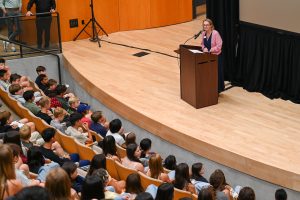
Beck addresses Windward students. Photo: Windward Communications.
What are the biggest issues/challenges educators and students need to navigate in the coming years and how can we respond to those things?
I think tolerance for nuance and uncertainty are the biggest challenges that frankly, humanity faces right now. I think we’ve been through a lot in the last 5-10 years in particular and people are so desperate for certainty that it [tolerance] is harder and harder – and I think adults are worse at this than kids are. We are so desperate for certainty so we retreat into oversimplified, polarized, or divided modes of viewing the world. We want to rush towards certainty and so we don’t tolerate the discomfort of “I don’t know what’s going to come our way and we can’t fully prepare, so all we can do is get better at navigating change, and get better at connection, and humanity, and these softer, squishier skillsets.” But I truly think that’s it. I think these schools that are going all in on AI and the schools that are totally resisting AI – that’s not going to work. We have to tolerate that nuance and that uncertainty of what it’s going to look like and that middle ground. But I believe that we can do that and do it well. That means that we’re producing young adults who are better equipped to solve problems in more creative, innovative, and impactful ways.
Are there any interesting or exciting trends that you’ve noticed in education?
I think overall, Windward is an exciting trend in education. For a very long time, Windward has said that you don’t need to crush kids to prepare them. Right now, that is very trendy. All of us are saying that we can do rigor without grind, but Windward has not only been saying that, but they’ve been doing that for decades. I think that’s a really exciting trend in education because it’s really healthy and it’s worth pursuing. More and more schools are trying to figure that out.
It’s really hard to do because it’s a culture thing and a mindset thing. You need faculty, staff, parents, and kids to all believe that you can be challenged through connection and not through just busy work. It’s hard to replicate, but Windward’s got it figured out.
Photo: Windward Communications
What are some Windward traditions that you’d like to maintain and what are some traditions you’d like to introduce?
I can think of so many that I want to maintain. I really loved Tales at the Table. The storytelling piece of it is powerful. I think that’s really special. I don’t know that Begin with Belonging is necessarily a tradition, but I like how much emphasis there is at the beginning of the year on connection. I love the retreats and trips that exist; I think those are really important parts of the curriculum. I’m excited for Coffeehouse. I really loved W!T and being a part of it was super fun, so those are traditions that I feel are super important. I haven’t even been to some of them and I know that they capture the spirit of Windward.
Ones I’d like to start…I don’t know. The fact that we can all fit in the gym together is pretty cool, so I think there’s some real opportunity to find moments for us to come together beyond things like the Big Windward Read and have moments where we ground ourselves. Particularly when there’s so much going on with current events, maybe there are opportunities for us to come together on topics that feel meaningful to us in a different way without cutting into too much class time and free time.
If you were to teach a class at Windward, what would it be?
Any of the history classes. I’m a history teacher by training. I used to teach U.S. history to 7th and 8th graders. I think if I were going to teach a class tomorrow, I would teach a class on challenging conversations and how kids can have difficult conversations in meaningful ways.
Those of us here today are seniors, what advice would you give us in our final year at Windward both in terms of this year and we think about what’s next?
I would say that when I was your age, I undervalued and underappreciated just how powerful of a grounding my [middle and high school] classmates would be for me. The advice I would give is…focus on coming together as a class, both with your close friends – soak up all that time – and by branching out and connecting as a larger group, which I absolutely see you guys doing. It’s been really wonderful. Don’t be afraid to rely on that as you get older. Certainly when you’re in college, stay in touch with each other, reach out, use that as a network. And network sounds so…I don’t know, business-y and transactional, but I really do mean it. There are going to be people in your life who hold you up and surprise you and that you connect with. So stay in touch and don’t be shy about using Windward when you’re in your future endeavors in life.
What was the experience like participating in the W!T faculty match?
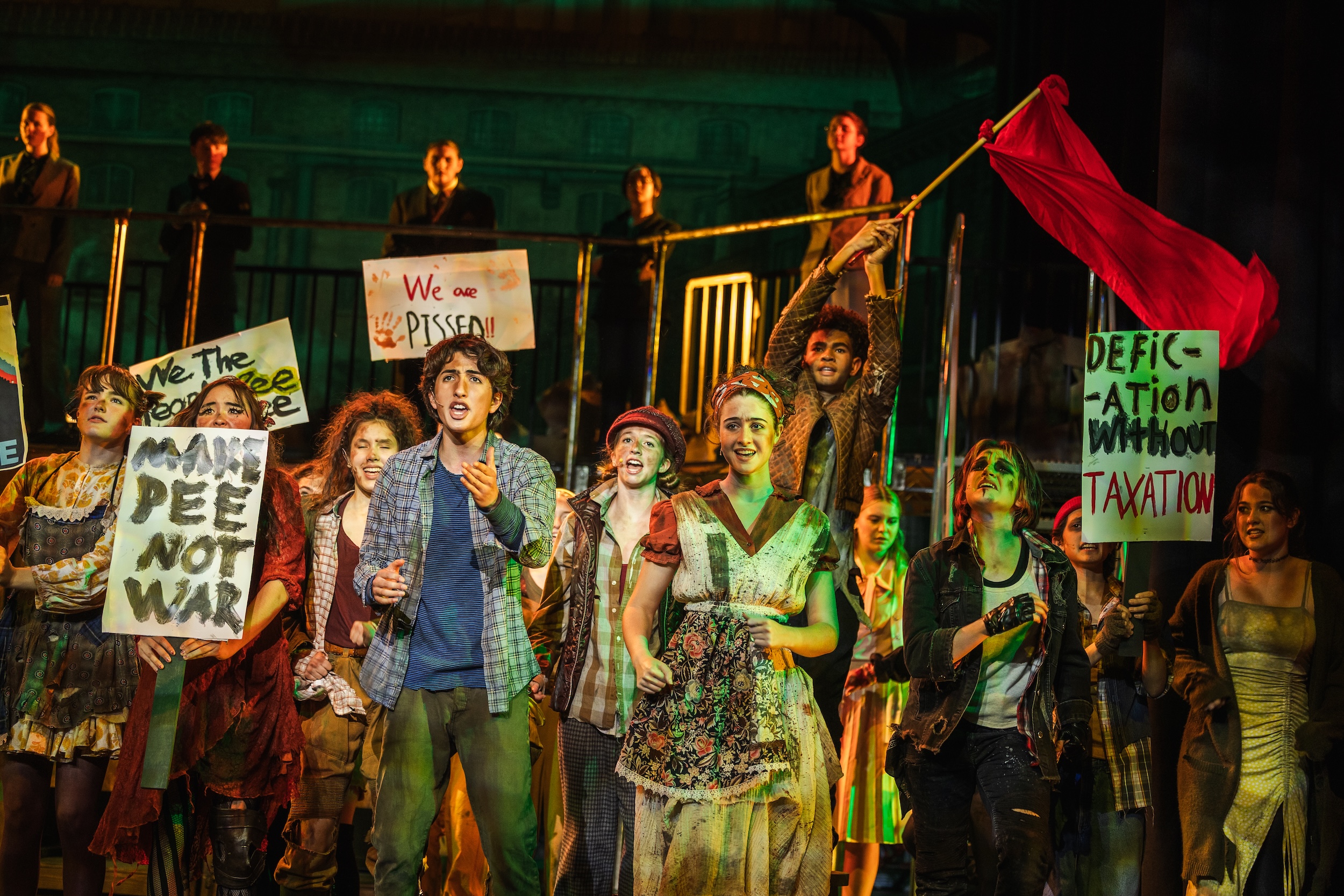
I loved it. It was so fun. Truly, it was the students who made me feel comfortable doing it. I was very nervous and the students kept coming up to me and they were like “oh my gosh we’re so excited that you’re going to do this!” And then I went into rehearsal and the students were so encouraging – literally cheering me, chanting, “Sa-rah Beck! Sa-rah Beck!” It felt really fun to be a part of something. I also feel like the most important thing you can do as a leader is set the tone and the tone I want to set is that it is okay to be vulnerable, it is okay to put yourself out there, and it’s important to have fun. If you can’t do those things, then why bother? It was so fun. Being up on that stage was an oh my goodness moment with all the lights. And the things that I did that people ended up thinking were the funniest were things that I didn’t even realize I had done. The advice I’d been given was “don’t try too hard” and that definitely helped out. It was a highlight of my Windward experience so far. Hands down.
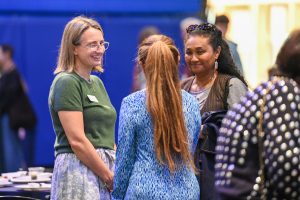
Photo: Windward Communications
Are you a dog or a cat person?
Oh, I’m a dog person. 100%. I mean except for, “Go Wildcats!”, but other than that, I’m a dog person. I’ve always had dogs growing up and we still have dogs now. I have a dog named Mary, she’s 45 pounds. She’s a hound dog, but she’s a rescue, so some sort of mutt. But she has very long legs so we call her Cindy Pawford. She’s very sweet.
What is your favorite food in the pavilion so far?
The poke bowl, I really like…. yeah, that’s going to be my final answer.
What’s your favorite song right now?
I know this is so basic, but I’m going to say it anyway. “Opalite,” from Taylor Swift’s new album. I really like it! It’s very catchy. Whenever I’m about to do any sort of big speaking or presentation, I always, always, always listen to Fleetwood Mac. Usually, “Go Your Own Way” is what I listen to as my hype up jam.
What’s the last great book you read, movie you saw or TV show you watched?
Oh my gosh, so many. I really liked Project Hail Mary. I read that over the summer. That was really good. I feel like that gets at humanity and pieces of the puzzle. The ending really got me. I didn’t expect it and I found it really meaningful. I read Atmosphere by Taylor Jenkins Reid and I love her. I love all of her work, so that was fun to read. I love Bob’s Burgers. I’ve been watching Wednesday Season 2.
About the Author: Sydney Litt


Stay up-to-date!
Get the latest Windward stories sent straight to your email.